The Norwegian government has tabled a bill for a new abortion law. In that proposal, the word “woman” is replaced by “the pregnant one”. And it is unclear about sex-selective abortions. The bill in six questions.## Why did the government take out the word “woman”? The government has yet not explained why it changed the wording. It is only mentioned in the media. In the present abortion law from the late seventies, the word was used 34 times. In the Christian daily Vart Land, a spokesperson for the Norwegian Society for Women Affairs (NKF) calls this “unfortunate and sad”. The society fears that gender-neutral wording in legal texts leads to less protection for women. The pro-life organisation Menneskeverd points to the legal possibility of sex change in Norway. “A woman can change her legal sex to man and still become pregnant”, says Maria Selbekk of Menneskeverd in an interview with CNE. “That possibility could have led to the wording of “the pregnant one”.” Why is Norway considering a new abortion law? The present law on termination dates from the late seventies. At the time, abortion was seen as an emergency option. Nowadays, the opinion has shifted towards abortion being a right. This has led to a long debate about a prolongation of the abortion period from twelve to eighteen weeks, or even longer, as CNE reported earlier. Other countries, like Denmark and Sweden, have made the exact change.How free must abortion be after the 12th week? Parties in Norway differNorwegian Health Minister Jan Christian Vestre said in his presentation of the new bill that he sees women's self-determination as a “fundamental value” for Norway. The parties in (and around) the minority coalition also favour a change. Will there be a conscience clause in the law?The Norwegian government will make the conscientious objection legal for the first time. There has always been room for “reservation”, as they call it in Norway. That means that personnel in hospitals who do not want to participate in abortion will never be obliged to do that.Norwegian committee advises liberalisation of abortion Until now, this has always been part of regulations in the field of care institutions in Norway. And it will be enshrined in the law. In that respect, the position of people who are against abortion gets stronger. All political parties seem to agree with this, so there is no debate about it.In neighbouring Sweden, this is different. There is no right to reservation. In 2021, two Swedish midwives lost a court case about this and started working in Norway.European Court does not rule on midwives’ participation in abortion What arguments does the pro-life movement use?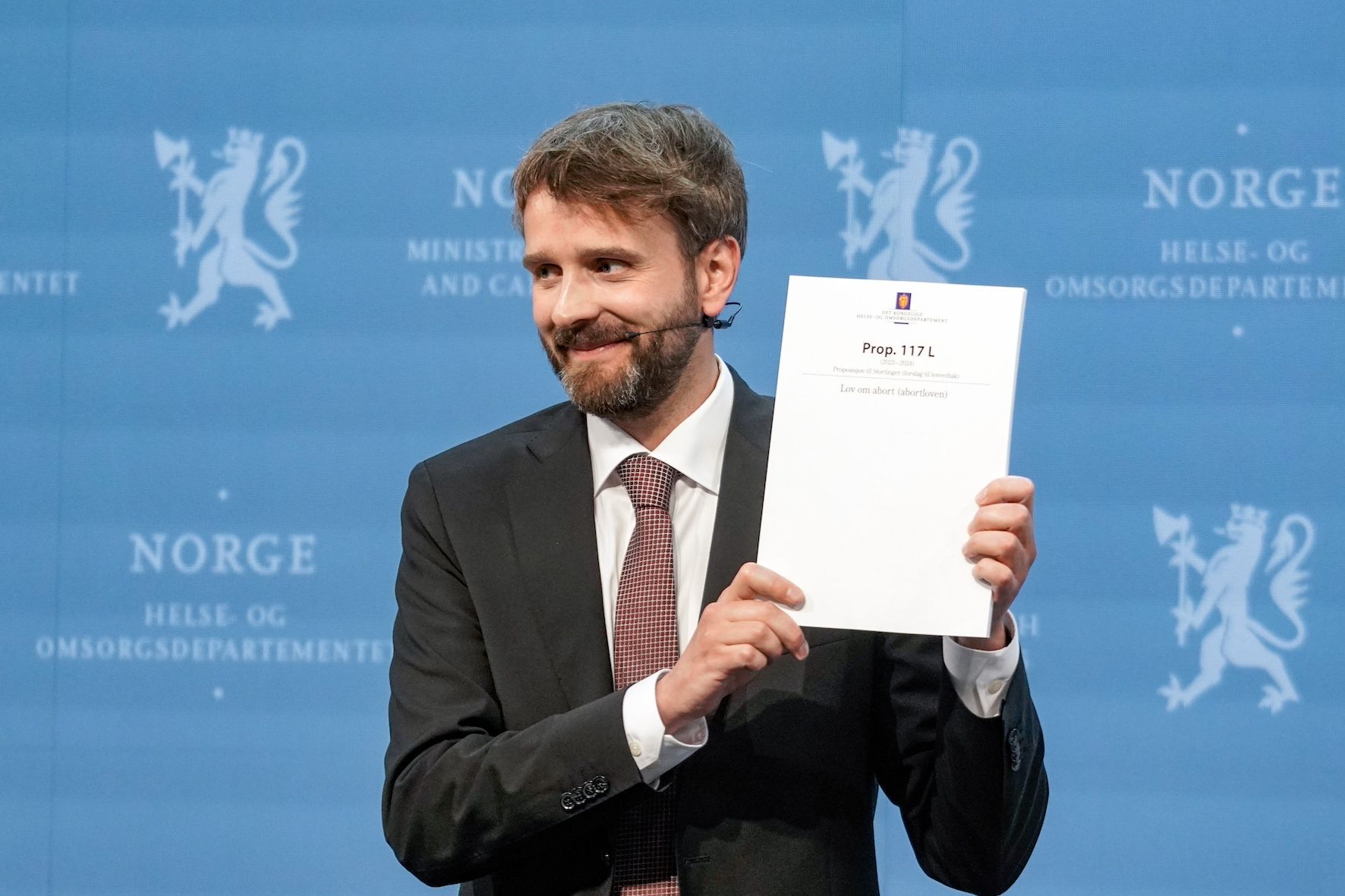
Health Minister Vestre at the bill's presentation late August. Photo EPA, Thomas FuThe organisation Menneskeverd has warned against the introduction of sex-selective abortions in Norway. Until now, doctors and midwives are forbidden to tell the foetus's sex before twelve weeks. But this ban is not prolonged until the eighteenth week. “As the text of the bill is now, sex-selection is possible”, says Maria Selbekk. “Before the debate and the vote, we will speak about this with members of the parliament to get this changed.” In Sweden, Selbekk says, it is forbidden to tell the parents whether it is a boy or a girl until the 18th week. Another issue for the pro-life movement is the “twin abortions”. Since 2019, it has been mandatory to meet with a special commission if a mother applies to abort one or more foetuses, even if the pregnancy was before the twelve weeks. However, according to the government's proposal, this obligation will be abolished. Menneskeverd prefers to uphold the rule. “Again, in Sweden, a twin abortion is only allowed if one of them is sick.”Norway reviews abortion legislation What will the position of the abortion committees be? Norway created special abortion committees (or tribunals, as they are called) to speak with women if they applied for an abortion after twelve weeks. Eight out of ten terminations are done within twelve weeks. However, the commission has to discuss a few hundred cases each year. In most cases, this is about a particular illness the baby has. The first question that the tribunal members ask is whether the application for abortion is made voluntarily. The commission says no to a request in a few cases (between 5 and 10 per cent). The function of those committees will not change. The main change is that the tribunals will speak about requests for over eighteen instead of twelve weeks. The utter maximum for an abortion in Norway will remain at 21 weeks and six days. The commission's position has been debated for a long time, as CNE reported in 2021. The government has not listened to the voices calling for the tribunals to be abolished altogether. What is expected of the vote? Abortion is a dividing issue in Norway, both for the population and for the parties. The government only has support from a minority coalition in the parliament. But now, it seems that the bill will receive a majority vote. The goal is to have the whole issue settled before Christmas.
Health Minister Vestre at the bill's presentation late August. Photo EPA, Thomas FuThe organisation Menneskeverd has warned against the introduction of sex-selective abortions in Norway. Until now, doctors and midwives are forbidden to tell the foetus's sex before twelve weeks. But this ban is not prolonged until the eighteenth week. “As the text of the bill is now, sex-selection is possible”, says Maria Selbekk. “Before the debate and the vote, we will speak about this with members of the parliament to get this changed.” In Sweden, Selbekk says, it is forbidden to tell the parents whether it is a boy or a girl until the 18th week. Another issue for the pro-life movement is the “twin abortions”. Since 2019, it has been mandatory to meet with a special commission if a mother applies to abort one or more foetuses, even if the pregnancy was before the twelve weeks. However, according to the government's proposal, this obligation will be abolished. Menneskeverd prefers to uphold the rule. “Again, in Sweden, a twin abortion is only allowed if one of them is sick.”Norway reviews abortion legislation What will the position of the abortion committees be? Norway created special abortion committees (or tribunals, as they are called) to speak with women if they applied for an abortion after twelve weeks. Eight out of ten terminations are done within twelve weeks. However, the commission has to discuss a few hundred cases each year. In most cases, this is about a particular illness the baby has. The first question that the tribunal members ask is whether the application for abortion is made voluntarily. The commission says no to a request in a few cases (between 5 and 10 per cent). The function of those committees will not change. The main change is that the tribunals will speak about requests for over eighteen instead of twelve weeks. The utter maximum for an abortion in Norway will remain at 21 weeks and six days. The commission's position has been debated for a long time, as CNE reported in 2021. The government has not listened to the voices calling for the tribunals to be abolished altogether. What is expected of the vote? Abortion is a dividing issue in Norway, both for the population and for the parties. The government only has support from a minority coalition in the parliament. But now, it seems that the bill will receive a majority vote. The goal is to have the whole issue settled before Christmas.
| onardo De Chirico Prof. Dr. Leonardo De Chirico is pastor of Breccia di Roma, a church plant in Rome that started in 2009. He also planted an evangelical church in Ferrara, Italy, in 1997. De Chirico was vice-chairman of the Italian Evangelical Alliance from 2003-2021. He received a PhD in theology from King's College in London, UK. He is a professor of Historical Theology at Istituto di Formazione Evangelica e Documentazione in Padova, Italy. Additionally, Leonardo is the Director of the Reformanda Initiative, which aims to equip evangelical leaders to understand Roman Catholicism better and engage with Roman Catholicism, and the leader of the Rome Scholars & Leaders Network (RSLN). He has written several books about the difference between Roman Catholic and Protestant theology. |