In the Dutch town of Arnhem, community service officers are now allowed to wear a headscarf, kippah or turban with their uniform. With this policy, the city council is diametrically opposed to the national government.
It was only last December when a majority of the House of Representatives in The Hague agreed that these religious expressions do not fit with a uniform. The majority of parties believe that, just like police officers, community service officers must appear neutral.
In Arnhem, however, things go different. A majority of the municipal council agreed upon a proposal by left-leaning party Denk/United Arnhem and the liberal D66. In doing so, the parties instruct the city government to change the dress code of the law enforcers.
Neutral
Ruud Kuin, the chairman of the Dutch union for community service officers, is not happy with the proposal. “A citizen must be able to trust that an enforcer is completely neutral.” According to Kuin, this includes a neutral uniform. “It is for a reason that we have separation of church and state.”
Kuin indicates to the regional newspaper de Gelderlander that he does not know any community service officers who are burdened by the fact that they have to do their work without a headscarf or kippah. “It's a solution to a non-existent problem. It's completely nonsensical. Don't those people in the city council have better things to do?”
Similar proposals
Arnhem is not the only municipality that challenges the national government. In Amsterdam and Utrecht, similar proposals got a majority in their municipal councils. Now, Martien Louwers, the municipal officer responsible for this topic in Arnhem, will discuss with the other municipalities the next steps.
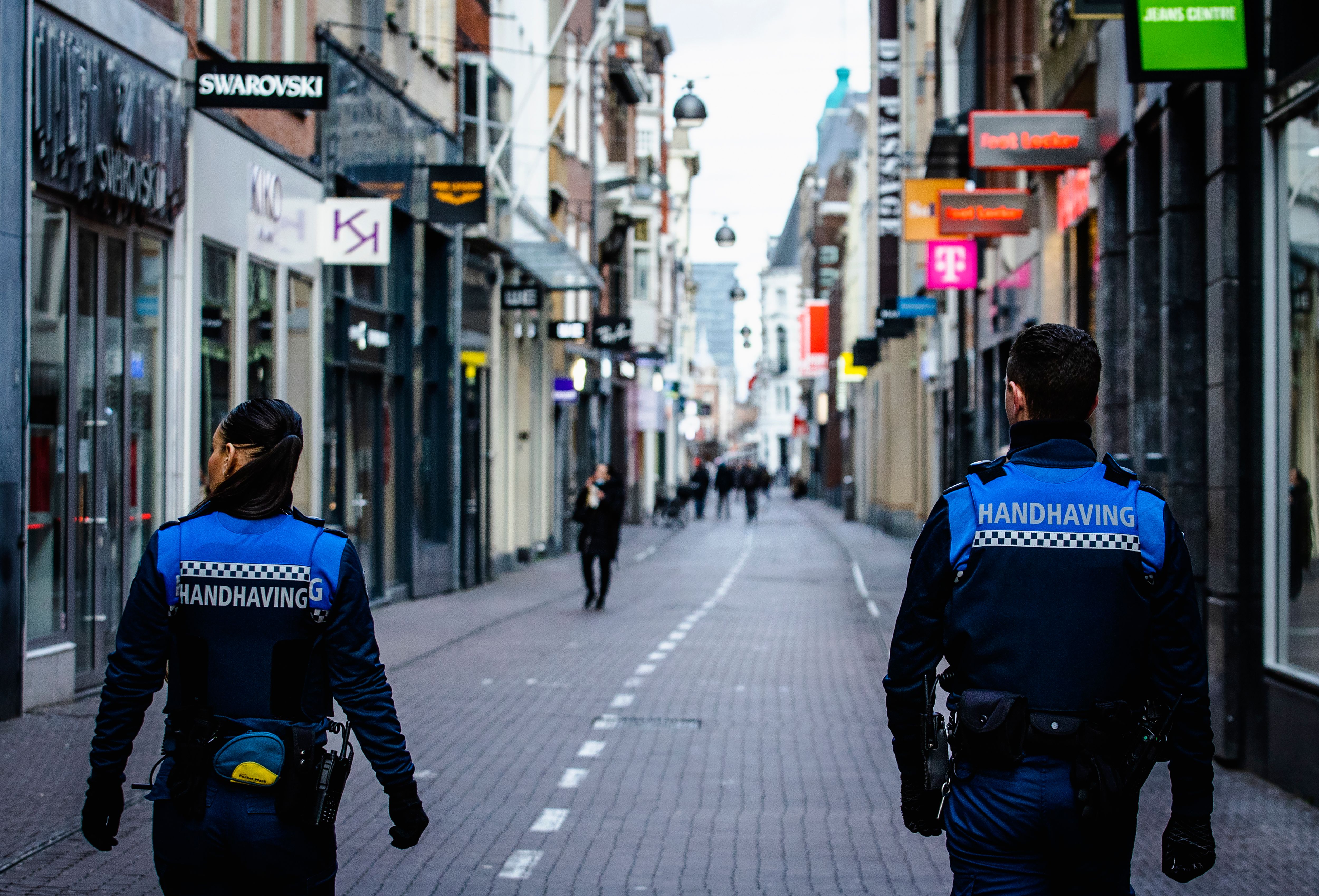
Photo ANP, Sem van der W According to Wierd Duk, a journalist and political commentator, the national government should interfere. This reports the Dutch public broadcaster WNL. “The most hypocritical thing about this plan is that it says: community service officers can wear a headscarf and also a kippah. As if that's comparable. Because how many people with a kippah actually work as a police officer or community service officer?” According to Duk, the kippah is only mentioned to “obscure” the fact that it concerns the headscarf. Duk says so in the Dutch TV show Goedemorgen Nederland. (Good morning Netherlands). “There is a powerful Islamic lobby, within the police, but also within politics, to eventually legitimise a headscarf for law enforcement as well.” Ban According to a legal analysis on behalf of the European Commission in 2017, Greece, Hungary, Ireland and Italy do not have any laws that prohibit the wearing of religious clothing or symbols in public employment. Denmark has similar laws as the Netherlands, whereas a public servant, it is not allowed to wear religious symbols when you have a judiciary or law enforcing job. There is a blanket ban on all religious clothing and symbols in public employment in France.
Photo ANP, Sem van der W According to Wierd Duk, a journalist and political commentator, the national government should interfere. This reports the Dutch public broadcaster WNL. “The most hypocritical thing about this plan is that it says: community service officers can wear a headscarf and also a kippah. As if that's comparable. Because how many people with a kippah actually work as a police officer or community service officer?” According to Duk, the kippah is only mentioned to “obscure” the fact that it concerns the headscarf. Duk says so in the Dutch TV show Goedemorgen Nederland. (Good morning Netherlands). “There is a powerful Islamic lobby, within the police, but also within politics, to eventually legitimise a headscarf for law enforcement as well.” Ban According to a legal analysis on behalf of the European Commission in 2017, Greece, Hungary, Ireland and Italy do not have any laws that prohibit the wearing of religious clothing or symbols in public employment. Denmark has similar laws as the Netherlands, whereas a public servant, it is not allowed to wear religious symbols when you have a judiciary or law enforcing job. There is a blanket ban on all religious clothing and symbols in public employment in France.